8 Ways to Cut Your Wedding Budget That Guests Won't Notice
Save $5,000–$15,000 on your wedding without downgrading the experience. These eight cuts are invisible in photos and unnoticeable to guests.
> **Quick Answer:** The three cuts with the largest impact are: choosing a Friday or Sunday date (saves 20–30% on venue cost), switching from plated dinner to buffet service (saves $20–$35 per person), and trimming 20–30 guests from your list (saves $3,000–$6,000 in catering and supporting costs).
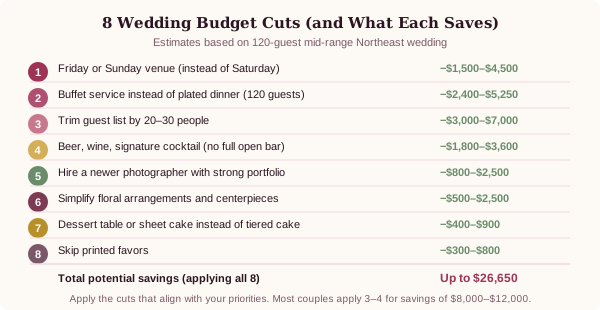
The Right Way to Cut a Wedding Budget
Cutting a wedding budget is not about downgrading your vision. It is about identifying where money gets spent that guests never notice, appreciate, or remember versus where money creates lasting impact. The categories that generate memorable moments (food quality, music energy, great photography) deserve your strongest budget allocation. The categories that are invisible in three months (chair style, invitation paper weight, aisle runner) are where you find the savings.
Run our [wedding cost estimator](/wedding-cost-estimator) to establish your baseline, then apply these cuts to bring the total within your available budget.
Cut 1: Choose Friday or Sunday Instead of Saturday
**Potential savings: $1,500–$4,500 on venue cost alone**
This is the single highest-leverage cut available. Most wedding venues have two pricing tiers: Saturday (peak demand) and everything else. Friday and Sunday weddings at the same venue with the same guest count cost 20–30% less — because the venue is filling a harder-to-sell slot and competing more aggressively for your business.
The guest concern is real but manageable. Most guests attending your wedding are close family and friends who will take a day off work or adjust their Sunday plans for an event this significant. Destination guests are already arranging travel regardless of the day. The couples who worry most about a Friday wedding are often surprised by how many guests tell them they preferred the less rushed Saturday-after-Sunday-wedding experience.
Cut 2: Switch from Plated Dinner to Buffet or Stations
**Potential savings: $20–$35 per person ($2,400–$5,250 on a 120-guest wedding)**
Buffet service costs less because it requires fewer service staff — roughly one server per 20–25 guests versus one per 8–10 for plated service. The food quality is often identical. The guest experience is frequently better, because buffets create natural movement, conversation at the food stations, and the ability to take exactly what you want.
The one execution note: a buffet requires more careful traffic flow design. Work with your caterer to ensure there are enough serving stations relative to your guest count, and that the layout does not create bottleneck lines.
Cut 3: Trim Your Guest List by 20–30 People
**Potential savings: $3,000–$7,000 depending on your catering tier**
This is emotionally the hardest cut, but financially the most effective. Every guest you remove saves their catering cost ($115–$140 at mid-range), their chair and table allocation, their stationery (invitation, place card, favor), and their slice of the cake. Removing 25 guests from a mid-range Northeast wedding saves approximately $5,000–$6,500 in direct costs.
The conversation to have: create your guest list in tiers. Tier 1 is non-negotiable (immediate family and closest friends). Tier 2 is important-but-not-essential (extended family, work colleagues). If your budget requires cuts, trim from tier 2. Guests who are not invited to the wedding but are important to you can be invited to a separate celebration — an engagement party, a dinner afterward, or a post-wedding gathering.
Cut 4: Limit the Open Bar
**Potential savings: $15–$30 per person ($1,800–$3,600 on a 120-guest wedding)**
A full open bar (beer, wine, well spirits, call spirits, premium spirits) at a wedding reception is a surprisingly large expense. Most of that expense covers spirits that a minority of guests drink.
The high-impact alternative: offer beer, wine, and one signature cocktail with the couple's name or a wedding theme. This covers the experience of having "a bar" without the cost of a fully stocked open bar. Many guests prefer this to a generic full bar because it creates a memorable custom touch.
If your venue requires alcohol service through their caterer, ask specifically about their beer-and-wine-only package — the per-person savings are often $15–$25.
Cut 5: Hire a Newer Photographer with a Strong Portfolio
**Potential savings: $800–$2,500 versus an established photographer**
Photography pricing correlates with experience, reputation, and demand — but not always with output quality. A photographer in their third year of business who has shot 30–40 weddings and is building their portfolio often produces work comparable to a 10-year veteran at $1,000–$2,000 less.
The way to find them: look at photographers who have been shooting for 2–4 years and have a full gallery of real weddings on their website (not just styled shoots). Ask to see photos from an entire event, not just the curated highlights. Check that they have a backup plan if they become ill on your wedding day (this is non-negotiable regardless of experience level).
What you are trading off: an established photographer has seen virtually every logistical scenario. A newer photographer may need more explicit direction on your priorities for the day.
Cut 6: Simplify Floral Arrangements
**Potential savings: $500–$2,500 depending on your original floral plan**
Floral costs are heavily concentrated in two areas: bridal bouquet and table centerpieces. A large cascading bridal bouquet costs $350–$700+. A simple garden bouquet of your favorite flowers costs $150–$250 and photographs just as beautifully in most cases.
For centerpieces, the cost difference between elaborate florals and simple alternatives is significant. Potted plants as centerpieces cost $15–$30 each versus $150–$350 for traditional floral centerpieces — and guests take the plants home as favors, which removes the need for a separate favor budget.
Candles, greenery, and minimalist arrangements consistently photograph well and cost a fraction of traditional centerpiece pricing.
Cut 7: Serve Dessert Instead of a Full Cake
**Potential savings: $400–$900**
A tiered wedding cake for 120 guests from a premium bakery runs $600–$1,200. A dessert table with assorted pastries, macarons, or cookies serves the same purpose at $250–$500. A single-tier cutting cake (for the photo) plus a sheet cake for serving guests costs $200–$350.
The cake-cutting photo still happens. Guests still get dessert. The savings are real and entirely invisible to your guests.
Cut 8: Skip Printed Favors
**Potential savings: $300–$800**
Per-guest favor costs range from $3–$8 for typical printed or personalized items — $360–$960 for a 120-guest wedding. Most favors are left on tables at the end of the night or discarded.
If favors matter to you, channel the budget into something consumable: a cookie, a small plant, or a custom cocktail at the bar. If favors do not personally matter to you, skip them entirely. No guest has ever left a wedding disappointed because there was no keychain or picture frame.
The Cumulative Impact
Applying all eight of these cuts to a mid-range 120-guest Northeast wedding:
- Friday venue instead of Saturday: −$2,500
- Buffet instead of plated dinner: −$3,600
- Trim 20 guests: −$4,500
- Beer-wine-signature cocktail bar: −$2,400
- Newer photographer: −$1,500
- Simplified florals: −$1,200
- Dessert instead of tiered cake: −$600
- Skip favors: −$480
**Total potential savings: $16,780**
You would not apply every cut to every wedding — some conflict with your priorities and vision. But even applying three or four of these consistently saves $8,000–$12,000 on a mid-range wedding.
Start by [estimating your wedding cost](/wedding-cost-estimator) to establish your baseline. Then identify which categories represent the largest opportunities relative to your priorities, and apply the cuts that make sense for your specific situation. The goal is not the cheapest wedding — it is the wedding you want at a price that does not start your marriage with financial stress.
For a complete guide to building your wedding budget from the starting number, see [how to build a wedding budget from scratch](/blog/how-to-build-wedding-budget).