What Affects Wedding Costs Most? 7 Key Factors
Guest count and venue type drive more of your wedding budget than any other decisions. Here is a clear breakdown of all 7 factors that move the number.
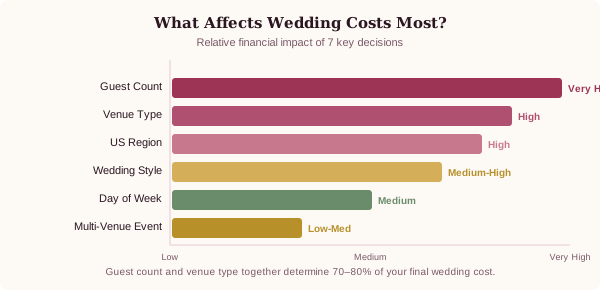
> **Quick Answer:** Guest count is the single largest lever (catering scales at $100–$140 per person at mid-range). Venue type sets your floor. Region applies a multiplier to everything. These three factors together determine 70–80% of your final number.
Why Understanding Cost Drivers Matters
Most couples approach wedding planning with a fixed vision and variable budget. The more effective approach is to understand which decisions have the most financial impact, then make those decisions deliberately.
You cannot change your region. But you can change your venue type, your guest count, your day of week, and your style tier. Understanding the relative impact of each decision helps you make trade-offs that align with your priorities rather than cutting randomly.
[Use our wedding budget calculator](/wedding-cost-estimator) to see exactly how each of these factors affects your specific budget. The following analysis explains why each factor has the impact it does.
Factor 1: Guest Count (Highest Impact)
Guest count is the dominant variable in wedding cost because catering — the largest single expense category — scales at a fixed rate per person. Add one guest and you add $55–$280 in catering cost depending on your style tier, plus supporting costs in seating, stationery, and cake.
On a 120-guest mid-range wedding, the catering line alone is $13,800–$16,800. Each additional 10 guests adds $1,150–$1,400 in catering costs before any other adjustments. Add the seating, linen, centerpiece, place card, and invitation costs for those 10 guests, and the real cost of each additional 10-person increment is $1,500–$2,500.
This is why guest list decisions have such outsized importance. The difference between a 100-guest and 150-guest wedding of the same style is often $7,500–$12,500 in direct costs.
Factor 2: Venue Type (High Impact on Base Cost)
Venue type sets a base cost that is largely independent of guest count. A backyard wedding costs $500–$1,500 in permits and logistics. A luxury ballroom costs $10,000–$18,000 in venue fees before a single guest walks in.
But venue type also determines your total vendor infrastructure. A hotel provides tables, chairs, linens, kitchen, and staff. A barn venue requires you to bring all of those components in separately. The net cost difference between a hotel and a barn is often smaller than the venue fee difference because the hotel fee includes infrastructure the barn does not.
The [wedding venue types comparison guide](/blog/wedding-venue-types-compared) breaks down exactly what each venue type includes and what you need to add.
Factor 3: Geographic Region (Multiplier on Everything)
Your region does not change any category's importance — it multiplies all of them. Northeast and West Coast vendors charge 35–40% more than the national median for identical services. Midwest and South markets run 8–15% below national median.
The regional effect is cumulative. A $35,000 national median wedding becomes $48,000–$49,000 in the Northeast and $30,000–$31,000 in the Midwest — not because different things are being purchased, but because local market rates differ.
You cannot change your region for most couples. But you can account for it accurately in your planning rather than using national averages that do not reflect your market.
Factor 4: Wedding Style Tier (Multiplier on Vendor Costs)
Style tier — budget, mid-range, upscale, or luxury — functions as a multiplier on all non-catering vendor costs. Choosing "luxury" instead of "mid-range" does not just mean upgrading your flowers. It means:
- Photography: $2,800 → $7,300 (luxury multiplier of 2.6×)
- Flowers: $2,000 → $5,200
- Music: $1,800 → $4,700
- Venue: same base × 2.6× style multiplier
Luxury weddings do not cost twice as much as mid-range weddings — they cost 2.5–3× as much. The jump from mid-range to luxury is not linear.
Before selecting a style tier, run the numbers in our [wedding cost estimator](/wedding-cost-estimator). The difference between upscale and luxury is often $20,000–$35,000 on the same guest count. Make sure the visual difference is worth the financial gap.
Factor 5: Day of Week (Direct Impact on Venue Cost)
Saturday weddings carry a 20–30% premium over Friday and Sunday weddings at most venues. This applies to venue rental cost only — other vendors charge the same rate regardless of day.
For a mid-range 120-guest wedding with a $6,000 venue rental, this represents $1,200–$1,800 in direct savings. For a luxury ballroom at $12,000, the savings are $2,400–$3,600. The detail breakdown in the [Saturday vs. Sunday wedding cost comparison](/blog/saturday-vs-sunday-wedding-cost) shows this clearly.
Factor 6: Ceremony and Reception Location Separation
If your ceremony and reception are at the same venue, your coordination costs are minimal. If they are at different locations, add:
- Transportation between venues for the wedding party and potentially guests ($500–$2,500)
- Florals at both venues instead of one ($500–$1,500 additional)
- Potential overlap in vendor travel time charges
- Coordination complexity that increases the value of a day-of coordinator
Most couples underestimate the cost of a multi-venue wedding. The transportation requirement alone is often overlooked until quotes arrive.
Factor 7: Booking Timeline Relative to Peak Season
Vendors adjust pricing based on demand. A photographer with an open May Saturday will negotiate differently than the same photographer booking a September Saturday. Off-season dates (January through March in most US markets) command lower venue pricing than peak season (April through October).
The specific impact varies significantly by market and vendor, but peak-season premium on venue cost ranges from 10–25% over off-peak in most markets. Combined with the day-of-week premium, an off-peak Sunday wedding versus a peak-season Saturday can represent 35–45% lower venue cost.
How to Use This Analysis
The most effective approach: identify which of these seven factors you have the most flexibility to change, and model the financial impact of each change.
Guest count and venue type are often more flexible than couples initially assume. Region is not. Style tier is usually the last thing to change — couples are more attached to their vision of a luxury wedding than to having 150 guests versus 120.
Run multiple scenarios in our [wedding budget calculator](/wedding-cost-estimator): your target scenario, a 20-guest-smaller scenario, an off-peak date scenario. The comparison will show you exactly what each adjustment is worth in dollar terms.
For a complete guide to using these factors in your budget, see our [step-by-step wedding budget guide](/blog/how-to-build-wedding-budget).