How to Build a Wedding Budget From Scratch
A step-by-step guide to creating a wedding budget that works — from your first number to your final vendor contracts.
> **Quick Answer:** Start with your total available funds (not a wish number), run a wedding cost estimate to see what your budget can realistically buy, then allocate 45–50% to venue and catering first. Every other category gets funded from what remains.
Why Most Wedding Budgets Fail
The typical wedding budget failure follows a predictable pattern. A couple decides they want to spend $30,000. They start touring venues without adjusting their guest list first. They fall in love with a venue that costs $8,000 for a Saturday in their preferred season. They book a photographer at $4,500. Six months later, they realize $30,000 cannot cover a 130-guest wedding at a hotel with a professional photographer — and they either add to their budget or make painful cuts.
The fix is to start the budget before you start touring. Use a [wedding cost estimator](/wedding-cost-estimator) to understand what your budget actually buys before you have emotional attachments to specific vendors or venues.
Step 1: Establish Your Real Number
Before you can build a budget, you need an honest total. Add up:
- Your personal savings allocated to the wedding
- Contributions from parents or family (get a specific number, not a vague promise)
- Any financing you are comfortable carrying (be conservative; wedding loans are high-interest personal loans)
This is your ceiling. Write it down. Everything that follows is about allocating this number intelligently.
Do not set your budget by working backward from what you want — "we want a 150-person hotel wedding so our budget should be $45,000." Set it from what you actually have, then decide whether that covers what you want.
Step 2: Run an Estimate Before Booking Anything
With your total in hand, run our [wedding budget calculator](/wedding-cost-estimator) using your actual inputs. Put in your realistic guest count, your venue type preference, and your region. See what the total estimate looks like.
If the estimate is above your ceiling: you have three options. Cut the guest list (most effective — reducing from 150 to 100 guests saves $5,000–$7,000 in catering alone). Change venue type (hotel to barn or restaurant). Move to an off-peak date (Friday or Sunday saves 20–30% on venue cost).
If the estimate is below your ceiling: you have room to upgrade categories. More photography time, a live band instead of a DJ, premium florals.
Run the estimate at least three configurations before making any commitments. The comparison will show you clearly where the cost drivers are.
Step 3: Allocate Venue and Catering First
Venue and catering are your anchor costs because they are both guest-count-dependent and sequential — you cannot book other vendors until you have a confirmed venue date.
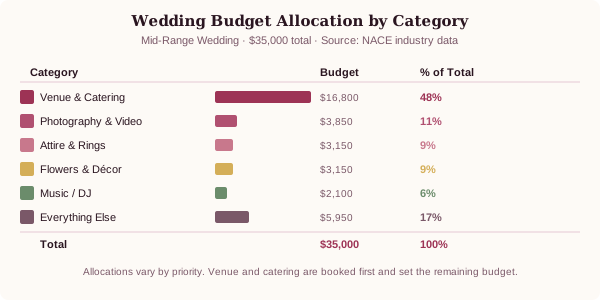
The National Association for Catering and Events (NACE) tracks industry-wide budget allocations. For mid-range weddings, venue and catering together typically consume 45–50% of total budget. On a $35,000 wedding, that is $15,750–$17,500. On a $50,000 wedding, that is $22,500–$25,000.
Allocate this slice first. Once you have real venue quotes in hand, you will know your actual catering budget rather than your estimated one.
Step 4: Fund Photography and Videography Next
Most couples with hindsight say they would have spent more on photography and less on florals. Photography and videography are the only wedding categories that produce a lasting artifact of your day. Everything else is consumed, returned, or discarded. Fund these generously.
Industry average at the mid-range tier is $4,800–$5,500 combined for photography and videography. If your total budget requires compromises, cut florals before cutting photography. If budget is tight, choose photography over videography rather than both at reduced quality.
Step 5: Allocate Remaining Budget by Category Priority
With venue, catering, and photography funded, distribute remaining budget by your personal priorities:
| Category | Typical % of Budget | Mid-Range $35k |
|---|---|---|
| Flowers & Décor | 8–10% | $2,800–$3,500 |
| Music (DJ or Band) | 5–7% | $1,750–$2,450 |
| Attire & Rings | 8–10% | $2,800–$3,500 |
| Cake & Desserts | 2–3% | $700–$1,050 |
| Stationery | 2–3% | $700–$1,050 |
| Hair & Makeup | 2–3% | $700–$1,050 |
| Transportation | 2–3% | $700–$1,050 |
| Officiant | 1–2% | $350–$700 |
These percentages shift based on your priorities. If music matters deeply to you, a live band instead of a DJ could consume 10–12% instead of 5–7% — and you adjust other categories accordingly.
Step 6: Build in a Contingency Buffer
Add 10–15% to your total allocated budget as a contingency line item. Do not spend it. Save it for the items that always appear: day-of tips for vendors (industry standard is 15–20% of the service fee for day-of tipping), unexpected overtime, vendor substitutions if someone cancels, and the inevitable "we did not think of that" purchases in the final weeks.
WeddingWire surveys consistently show that over 60% of couples spend more than their original budget. The typical overage is 12%. Planning the contingency into your budget means that overage is not a crisis.
Step 7: Track in a Spreadsheet, Not Your Head
Create a wedding budget spreadsheet with columns for: category, allocated amount, actual quotes received, deposit paid, balance due, due date. Update it every time you receive a quote or make a payment.
This matters most in the 6-month window before your wedding when deposits are coming due and final payments are being requested simultaneously. Seeing the cash flow requirements in advance prevents the surprise of three $2,000 deposits due in the same month.
The Biggest Budget Mistakes to Avoid
**Booking vendors before establishing a total budget.** Every commitment you make before you have a real number reduces your flexibility.
**Treating the estimate as a minimum.** The wedding cost estimate is a median — half of couples at your inputs spend more. Plan to the 60th percentile, not the median.
**Forgetting vendor gratuities.** Add $500–$1,500 for day-of tips across all vendors. It is not optional in the wedding industry.
**Ignoring the honeymoon.** Many couples blow their wedding budget and have nothing left for the honeymoon. Budget both together from the start.
Ready to see your numbers? [Estimate your total wedding cost](/wedding-cost-estimator) with our free wedding budget calculator. Then read our guide to [cutting your wedding budget without sacrificing quality](/blog/cut-wedding-budget-tips) for proven cost-reduction strategies.